





The term Psychological Contract gained popularity during the 1960s when its description and definitions were mentioned in the studies of behavioural and organizational theorists Chris Argyris and Edgar Schein. Since then, many other theorists and experts have contributed their insights on this subject and propounded several approaches or studies which have unveiled newer perspectives on this topic.
Psychological Contract explains those vital aspects which influence workplace relationships or the human behaviour in an organization. It is a complicated and deep concept, which is still under research and several theoretical studies and interpretations have been attached to it.
Primarily the term Psychological Contract focuses more on the dynamics of a relationship between the employer and the employees, is concerned with the mutual expectations in relation to the inputs and the outcomes.
In one of the definitions of Psychological Contract, more focus is laid on what the employer owes to their employees. It has been defined as “the mutual perceptions of the employers and the employees regarding their mutual obligations at work towards each other”. These obligations may be inferred, imprecise in nature, can be understood as some kind of promises or defining of mutual expectations and failure to meet the expectations lead to a breach of trust or faith.
Professor David Guest of Kings College, London has propounded a useful model on Psychological Contract (Guest and Conway 2004).
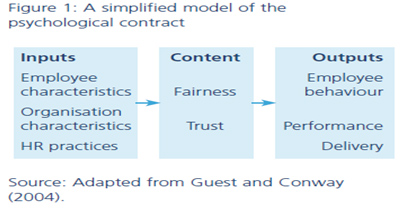
Following are the salient features of Guest Model of Psychological Contract:
- The psychological contract largely depends upon the extent to which the organization’s adopt and implement effect people management practices to promote the welfare of the employees and fulfill their expectations through employee-friendly practices.
- Employee commitment and satisfaction will increase if the psychological contract is positive, which is largely governed by the state of belief of employees that they would be treated fairly or transparently and that the employers are working upon their committed promises or the deal which was finalized mutually.
In the present scenario, the employee’s interpretation of psychological contract largely depends on job security, fair pay, fair treatment and ample opportunities for training development.
The employment relationship has witnessed a change owing to the challenges of the globalization of economies and changes in the way in which businesses are functioning in a global platform.
Few academicians like Rousseau (2004), have explained the distinction between Transactional and Relational Contracts.
The term relational contract is having a broader connotation, which essentially focuses on the quality of relationship which exists between the employer and the employee.
On the other hand, the transactional contract is more focused and defined more tightly by laying more focus on the tangible advantages such as working conditions and pay. In the contemporary scenario, importance is given to transactional contracts over relational contracts.
Research evidence in the recent period reveals that the Generation X or so-called Generation Y employees prefer a sense of excitement, community feeling or involvement and life outside the work. They expect to be respected and to be treated as humans. According to Woodruffe (1999), in their thesis stated that employees essentially want their requirements to be fulfilled:
- The Employee Reward and Pay Package: Attractive rewards and conditions of work help in the retention of the best of the talent and improves the overall employee productivity and work commitment. Moreover, the employees should equally need to feel that they are being treated fairly with regards to pay for achieving a positive psychological contract.
- Employability: This essentially focuses on career advancement opportunities for the employees and opportunities for personal growth and professional development by being a part of an organization.
Recent researches of CIPD reveal that employees love to be associated with that organization that they feel they will be proud of by working for them. It is due to this reason, the employers are adopting employer branding strategies in their day to day recruitment and talent management practices.
- Job Satisfaction: Woodruffe identifies the following factors which may have a direct linkage with the job satisfaction of employees and in turn will have a positive effect on the psychological contract of the employees. These factors are sense of purpose, achievement and direction, work life balance and harmony, autonomy and sense of involvement, fun at work and a sense of belongingness.
Relationship between Psychological Contract and Change Management
It may not be always possible for the organizations to avoid breaching the deal or the psychological contract, but proactive efforts can be made in terms of explaining the employees the reasons for the change, what needs to be addressed and how it is intended to be handled.
Re-negotiation of the contract can be made possible. For this, the line managers may be engaged in direct communication with the employees to understand their expectations and issues pertaining to change.
Top-down methods of communication should be avoided while renegotiating the contract with the employees. Crucial steps for the managers during the renegotiation of contracts are:
- Give a lot of importance to the people management related issues while planning change.
- Manage expectations by providing early warnings related to the implementation of a change in the organization.
- Seek employee involvement in the entire process of implementation of change. Make them own the change for involving them actively in the whole process.
- Communicate regularly with the employees and share crucial information with them on a regular basis. Maintain transparency in the process of communication for winning their faith.
- Consult the employees on the changes which are being proposed to be introduced or implemented across the organization and how the employees will be benefitted or their expected codes of conduct.
- Line Managers role during this stage is extremely critical. The complete success will depend upon the manner in which the line managers communicate with the employees.
In a nutshell, it may be concluded that management of change is a complicated process and if not planned and implemented properly may land up the organization into a problematic scenario.
Hence effective change management requires a carefully planned and a coordinated effort with complete involvement and committed approach from the employees involved.
Psychological Contract and the research evidence which has been shared through this article may provide a guiding framework to the HR functional department in implementing best practices in HR and best people management practices for deriving maximum success from the implementation of change initiatives across the entire organization.