




Related Articles

Classical Theories of Motivation Classical Theories of Motivation The motivation concepts were mainly developed around 1950’s. Three main theories were made during this period. These three classical theories are- Maslow’s hierarchy of needs theory Herzberg’s Two factor theory Theory X and Theory Y These theories are building blocks of the contemporary theories developed later. The working mangers and learned professionals till date use… Why Intrinsic Motivation Matters More Now In the Times of the Great Resignation Why Intrinsic Motivation Matters More Now In the Times of the Great Resignation What is Intrinsic Motivation and how does it tie in with the Great Resignation? Among the different types of motivation, Intrinsic Motivation, or the ability of individuals to motivate themselves according to their inner needs and higher selves, matters more than ever in the present Post Pandemic Times. This is because due to WFH or… Workplace Motivation – Carrot or Stick approach doesnt work anymore Workplace Motivation – Carrot or Stick approach doesnt work anymore “I am in this job because I have no other option.” If this is what an employee of your company feels, read on to know how this statement can be changed to something more positive – “I love what I do.” First things first – whose responsibility is it to ensure that an employee loves… How to Motivate Employees and Teams: Practical Strategies for Managers How to Motivate Employees and Teams: Practical Strategies for Managers Employees are the building blocks of an organization. Its success depends on their collective efforts, and they contribute most when they are motivated. Teams working toward a common goal also perform best when they are motivated as a team. This article offers practical tips for motivating individual employees, explains how to motivate a team as… Theory X and Theory Y Theory X and Theory Y In 1960, Douglas McGregor formulated Theory X and Theory Y suggesting two aspects of human behaviour at work, or in other words, two different views of individuals (employees): one of which is negative, called as Theory X and

Search with tags

  • No tags available.

To bring Maslow’s need hierarchy theory of motivation in synchronization with empirical research, Clayton Alderfer redefined it in his own terms. His rework is called as ERG theory of motivation. He recategorized Maslow’s hierarchy of needs into three simpler and broader classes of needs:

  • Existence needs- These include need for basic material necessities. In short, it includes an individual’s physiological and physical safety needs.

  • Relatedness needs- These include the aspiration individual’s have for maintaining significant interpersonal relationships (be it with family, peers or superiors), getting public fame and recognition. Maslow’s social needs and external component of esteem needs fall under this class of need.

  • Growth needs- These include need for self-development and personal growth and advancement. Maslow’s self-actualization needs and intrinsic component of esteem needs fall under this category of need.
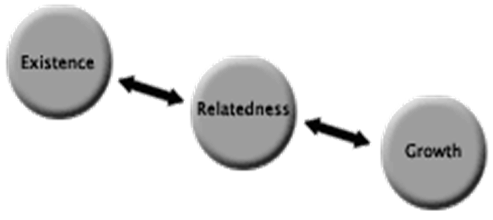
ERG Theory of Motivation

The significance of the three classes of needs may vary for each individual.

Difference between Maslow Need Hierarchy Theory and Alderfer’s ERG Theory

  • ERG Theory states that at a given point of time, more than one need may be operational.

  • ERG Theory also shows that if the fulfillment of a higher-level need is subdued, there is an increase in desire for satisfying a lower-level need.

  • According to Maslow, an individual remains at a particular need level until that need is satisfied.

    While according to ERG theory, if a higher-level need aggravates, an individual may revert to increase the satisfaction of a lower-level need. This is called frustration-regression aspect of ERG theory.

    For instance – when growth need aggravates, then an individual might be motivated to accomplish the relatedness need and if there are issues in accomplishing relatedness needs, then he might be motivated by the existence needs. Thus, frustration/aggravation can result in regression to a lower-level need.

  • While Maslow’s need hierarchy theory is rigid as it assumes that the needs follow a specific and orderly hierarchy and unless a lower-level need is satisfied, an individual cannot proceed to the higher-level need; ERG Theory of motivation is very flexible as he perceived the needs as a range/variety rather than perceiving them as a hierarchy.

    According to Alderfer, an individual can work on growth needs even if his existence or relatedness needs remain unsatisfied. Thus, he gives explanation to the issue of “starving artist” who can struggle for growth even if he is hungry.

Implications of the ERG Theory

Managers must understand that an employee has various needs that must be satisfied at the same time.

According to the ERG theory, if the manager concentrates solely on one need at a time, this will not effectively motivate the employee. Also, the frustration-regression aspect of ERG Theory has an added effect on workplace motivation.

For instance – if an employee is not provided with growth and advancement opportunities in an organization, he might revert to the relatedness need such as socializing needs and to meet those socializing needs, if the environment or circumstances do not permit, he might revert to the need for money to fulfill those socializing needs. The sooner the manager realizes and discovers this, the more immediate steps they will take to fulfill those needs which are frustrated until such time that the employee can again pursue growth.

Author Avatar

Article Written by

Jyoti Budhraja

Jyoti Budhraja is a multifaceted professional with 18+ years of experience, uniquely combining corporate expertise with holistic wellness practices. She is a Certified Master Level Tarot Reader, Health Tarot Reader, and Master Certified Numerologist, alongside her extensive background in HR consulting, training facilitation, life coaching, and career guidance. Her approach integrates structured corporate methodologies with personalized guidance, enabling individuals and organizations to achieve sustainable professional and personal growth.


Article Written by

Jyoti Budhraja

Jyoti Budhraja is a multifaceted professional with 18+ years of experience, uniquely combining corporate expertise with holistic wellness practices. She is a Certified Master Level Tarot Reader, Health Tarot Reader, and Master Certified Numerologist, alongside her extensive background in HR consulting, training facilitation, life coaching, and career guidance. Her approach integrates structured corporate methodologies with personalized guidance, enabling individuals and organizations to achieve sustainable professional and personal growth.

Author Avatar

Article Written by

Jyoti Budhraja

Jyoti Budhraja is a multifaceted professional with 18+ years of experience, uniquely combining corporate expertise with holistic wellness practices. She is a Certified Master Level Tarot Reader, Health Tarot Reader, and Master Certified Numerologist, alongside her extensive background in HR consulting, training facilitation, life coaching, and career guidance. Her approach integrates structured corporate methodologies with personalized guidance, enabling individuals and organizations to achieve sustainable professional and personal growth.

Author Avatar

Leave a reply

Your email address will not be published. Required fields are marked *