





McKinsey 7S model was developed by Robert Waterman and Tom Peters during early 1980s by the two consultants McKinsey Consulting organization. The model is a powerful tool for assessing and analyzing the changes in the internal situation of an organization.
It is based on 7 key elements, which determine the organization’s success, which should be interdependent and aligned for producing synergistic outcomes. The model can be used widely in various situations where an alignment is required:
- For improving organizational performance.
- Analyzing and evaluating the effects of futuristic changes on the organization.
- Can be a useful framework during the situation of Merger and Acquisition involving striking an alignment between the key processes of an organization.
- Providing a recommendative framework for implementing a strategic plan of action.
- The model can be effectively applied to various teams or groups or projects as well.
The McKinsey 7 S model refers to the seven key interrelated or integrated elements of an organization which are subdivided into hard and soft elements:
The Hard elements are within the direct control of the management as it can be easily defined and identified. The following elements are the hard elements in an organization.
- Strategy: It is the plan of action, or the roadmap or the blueprint by way of which an organization gains a competitive advantage or a leadership edge.
- Structure: This refers to organizational structure or the reporting pattern.
- Systems: This includes the day to day activities in which the staff members involve themselves for ensuring the completion of their assigned tasks.
The Soft elements are less tangible and are difficult to be defined and identified as such elements are more governed by the culture. But according to the proponents of this model, these soft elements are equally important as the hard elements in determining an organization’s success as well as growth in the industry. The following elements are the soft elements in an organization:
- Shared Values: The superordinate goals or the core values which get reflected within the organizational culture or influence the code of ethics.
- Style: This lays emphasis on the leadership style and how it influences the strategic decisions, people motivation and organizational performance.
- Staff: The general staff or the capabilities of the employees
- Skills: The core competencies or the key skills of the employees play a vital role in defining the organizational success.
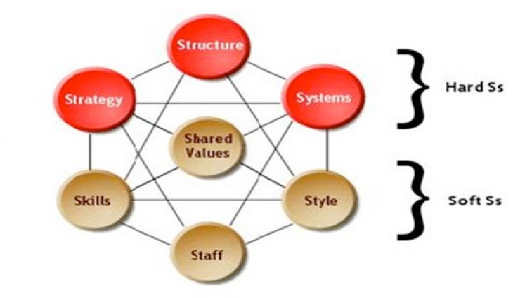
McKinsey 7S Model
As per the above diagram, the shared values in the center of the model influence all the other elements of the model which are interconnected and interrelated. The rest other elements originate from the very reason for the existence of the organization which is the vision which is formed by the creators of the values in an organization. If the values change, the rest other parameters equally undergo a change.
The 7S model identifies the inconsistencies or gaps between various elements and provides a strategic plan of action for reaching from the current state to the desired organizational state. The alignment between each element can be checked by paying attention to the following steps:
- Assessing the Shared Values: Assessing whether the shared values are in consistency with the elements such as structure, systems and strategy and if not then determining what may be changed.
- Assessing the Soft Elements as well as the Hard Elements in terms of interdependence and alignment between them and the possible course of action if these elements do not support each other.
- Making changes or adjustments and then analyzing whether these elements function in alignment or not.
According to Waterman and Peters, this model can be used by following five steps:
- The first step involves identification of those elements of the framework which do not align properly. It equally involves assessing the inconsistencies in the relationships between all the elements.
- The second step is concerned with the organizational design optimally and this optimal fit will be different for different organizations.
- The third step involves deciding the course of actions or the changes which are required to be implemented.
- The fourth step is the actual implementation of the change and
- The final stage or the fifth stage is the final review of the 7S framework.
Limitations of 7S Model
- Ignores the importance of the external environment and depicts only the most crucial elements in this model for explaining the interdependence of the key processes and factors within the organization.
- The model does not explain the concept of organizational effectivness or performance explicitly.
- The model has been criticized for lacking enough empirical evidences to support to support their explanation.
- The model is considered to be more of a static kind of model.
- It is rather difficult to assess the degree of fit with accuracy successfully.
- Criticized for missing out the intricate or finer areas in which the actual gaps in conceptualization and execution of strategy may arise.