





Henri Fayol’s 14 Principles of Management remain among the most widely studied and applied frameworks in management education. First published in 1916, they were derived from Fayol’s own experience as an industrialist and have shaped management thinking for over a century. This article explains each principle clearly, with real-world examples that show how they apply in modern organisations.
What are Management Principles?
A principle refers to a fundamental truth. It establishes a cause-and-effect relationship between two or more variables under a given situation. Principles serve as guides to thought and action. Therefore, management principles are statements of fundamental truth based on logic which provide guidelines for managerial decision-making and actions.
These principles are derived:
- On the basis of observation and analysis — i.e. practical experience of managers over many years
- By conducting experimental studies in real organisational settings
About Henri Fayol: Henri Fayol (1841-1925) was a French mining engineer and executive who became one of the most influential contributors to modern management theory. He served as the managing director of a large mining company for nearly 30 years, during which he developed his 14 principles — published in his landmark work ’Administration Industrielle et Générale’ (1916). Fayol is considered the father of modern management.
Quick Reference: All 14 Principles at a Glance
The table below summarises all 14 principles, their core idea, and a modern example for each — a useful overview before exploring each principle in depth:
| # | Principle | Core Idea | Modern Example |
|---|---|---|---|
| 1 | Division of Labour | Specialise work so each person masters their task — leading to efficiency and accuracy | Assembly line production where each worker performs one specialised task |
| 2 | Parity of Authority and Responsibility | Authority and responsibility must be equal — one without the other creates dysfunction | A project manager given responsibility for delivery must also have authority over resources |
| 3 | Unity of Command | Each subordinate should receive orders from one and only one superior | An employee reporting to two managers with conflicting instructions experiences confusion and stress |
| 4 | Unity of Direction | One plan, one head for a group of activities with similar objectives | A marketing team with one campaign plan, one budget and one manager coordinating all efforts |
| 5 | Equity | Managers should treat all employees with fairness, kindness and impartiality | Applying the same performance standards and disciplinary procedures to all staff regardless of seniority |
| 6 | Order | A place for everything and everything in its place — applies to both materials and people | A warehouse with clearly labelled storage locations; an HR system with defined roles for every position |
| 7 | Discipline | Employees must respect and observe organisational rules, agreements and authority | Clear attendance policies, consistently enforced — with fair consequences for repeated violations |
| 8 | Initiative | Employees should be encouraged and empowered to take initiative within their scope of work | A manager who invites team members to propose process improvements and acts on their suggestions |
| 9 | Fair Remuneration | Pay should be fair, reasonable and satisfying to both employer and employee | A company benchmarking salaries against industry data and offering non-monetary benefits alongside pay |
| 10 | Stability of Tenure | Employees need time to settle into a role and perform well — frequent transfers reduce effectiveness | An organisation with a structured onboarding programme and a minimum 12-month commitment before role changes |
| 11 | Scalar Chain | A clear chain of command from top to bottom — with a ’gang plank’ for urgent lateral communication | A large bank with a defined reporting hierarchy, plus authorised cross-departmental escalation paths |
| 12 | Subordination of Individual Interest | Organisational interests must take priority over individual interests when the two conflict | An employee setting aside personal preference for a different project to meet the team’s critical deadline |
| 13 | Esprit de Corps | Team spirit and harmony must be cultivated — unity is strength, division is weakness | A manager who rotates team leadership on projects to build cohesion and shared ownership |
| 14 | Centralisation and Decentralisation | The right balance of central authority vs delegated decision-making depends on context and scale | A startup centralises key decisions with the founder; a global corporation decentralises to regional heads |
The 14 Principles of Management — Explained in Detail
-
Division of Labour
Henri Fayol stressed the specialisation of jobs. He recommended that work of all kinds must be divided, subdivided and allotted to various persons according to their expertise in a particular area.
- Subdivision of work makes it simpler and results in efficiency
- It helps the individual in acquiring speed and accuracy in performance
- Specialisation leads to efficiency and economy across all spheres of business
Modern example: In a software company, developers specialise in front-end, back-end or DevOps rather than doing everything themselves. This mirrors Fayol’s principle — specialisation produces faster, higher-quality output than generalisation.
-
Parity of Authority and Responsibility
Authority and responsibility are co-existing — they must always be balanced.
- If authority is given to a person, they should also be made responsible
- If anyone is made responsible for a job, they should also have the necessary authority to carry it out
- Authority refers to the right of superiors to get exactness from subordinates; responsibility means the obligation to perform the job assigned
- There should always be a balance between the two — they must go hand in hand
- Authority without responsibility leads to irresponsible behaviour
- Responsibility without authority makes the person ineffective — they are accountable for outcomes they cannot control
-
Unity of Command
A subordinate should receive orders and be accountable to one and only one boss at a time. A subordinate should not receive instructions from more than one person, because dual command:
- Undermines authority
- Weakens discipline
- Divides loyalty
- Creates confusion
- Causes delays and chaos
- Encourages escaping of responsibilities
- Results in duplication of work and overlapping of efforts
Therefore, dual subordination should be avoided unless it is absolutely essential. Unity of command provides the enterprise with a disciplined, stable and orderly existence. It creates harmonious relationships between superiors and subordinates.
Modern relevance: Matrix organisations — where employees report to both a functional manager and a project manager — frequently violate this principle, leading to exactly the confusion Fayol described. The most effective matrix structures clearly define which manager has priority on which decisions.
-
Unity of Direction
Fayol advocated one head, one plan — meaning there should be one plan for a group of activities having similar objectives.
- Efforts of all members of the organisation should be directed towards a common goal
- Without unity of direction, unity of action cannot be achieved
- In fact, unity of command is not possible without unity of direction
Unity of Command and Unity of Direction are often confused. The table below clarifies the distinction — they are related but serve different purposes:
Basis Unity of Command Unity of Direction Meaning A subordinate should receive orders and instructions from only one boss One head, one plan for a group of activities having similar objectives Nature Related to the functioning of individual personnel Related to the functioning of departments or the organisation as a whole Necessity Necessary for fixing responsibility of each subordinate Necessary for sound organisation and coordinated effort Advantage Avoids conflicts, confusion and chaos Avoids duplication of efforts and wastage of resources Result Leads to better superior-subordinate relationships Leads to smooth running of the enterprise Unity of direction is a pre-requisite for unity of command — but it does not automatically produce it.
-
Equity
Equity means a combination of fairness, kindness and justice. Employees should be treated with kindness and equity if devotion is expected of them.
- Managers should be fair and impartial while dealing with subordinates
- They should give similar treatment to people of similar position
- They should not discriminate with respect to age, caste, sex, religion, or personal relationships
- Equity is essential to create and maintain cordial relations between managers and subordinates
- However, equity does not mean the total absence of firmness — Fayol noted that at times, force and harshness might become necessary for the sake of equity
-
Order
This principle is concerned with proper, systematic arrangement of both things and people.
- Material order — there should be a safe, appropriate and specific place for every article, and every place should be effectively used for a specific activity or commodity
- Social order — selection and appointment of the most suitable person for each job. There should be a specific place for every person and every person should have a specific place, so that they can easily be contacted whenever need arises
Modern example: In lean manufacturing (inspired in part by Fayol), the 5S methodology — Sort, Set in order, Shine, Standardise, Sustain — is a direct application of the principle of order to the shop floor.
-
Discipline
According to Fayol: ’Discipline means sincerity, obedience, respect of authority and observance of rules and regulations of the enterprise.’ This principle requires that subordinates respect their superiors and obey their orders.
- Discipline is an important requisite for smooth running of the enterprise
- Discipline is not only required of subordinates — it is equally required of management
- Discipline can be enforced if there are good superiors at all levels
- Clear and fair agreements with workers are essential
- Sanctions (punishments) should be judiciously and fairly applied
-
Initiative
- Management should provide opportunities for employees to suggest ideas and experience new methods of work
- It helps in developing an atmosphere of trust and understanding
- People enjoy working in the organisation when their initiative is welcomed — it adds to their zeal and energy
- Initiative can be encouraged through both monetary and non-monetary incentives
Modern relevance: Google’s famous ’20% time’ — allowing engineers to spend a fifth of their time on self-directed projects — is a direct modern application of Fayol’s principle of initiative. It produced Gmail, Google Maps and AdSense.
-
Fair Remuneration
The quantum and method of remuneration paid to workers should be fair, reasonable and satisfactory — rewarding of the efforts made.
- As far as possible, remuneration should accord satisfaction to both employer and employees
- Wages should be determined on the basis of cost of living, work assigned, the financial position of the business, and prevailing wage rates
- Logical and appropriate wage rates reduce tension and differences between workers and management, creating a harmonious and positive atmosphere
- Fayol also recommended provision of other benefits such as free education, medical and residential facilities to workers
-
Stability of Tenure
Fayol emphasised that employees should not be moved frequently from one job position to another — the period of service in a job should be fixed.
- Employees should be appointed after careful recruitment and selection — but once appointed, their positions should be secured
According to Fayol: “Time is required for an employee to get used to new work and to succeed in doing it well; but if they are removed before that, they will not be able to render worthwhile service.”
- Premature removal means the time, effort and money spent on training the worker will go to waste
- Stability of job creates team spirit and a sense of belonging among workers, which ultimately improves both the quality and quantity of work
-
Scalar Chain
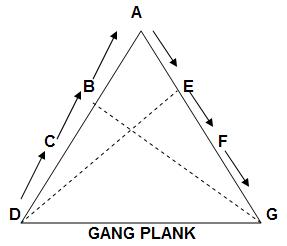
Fayol defines the scalar chain as ’the chain of superiors ranging from the ultimate authority to the lowest’. Every order, instruction, message, request or explanation must pass through this scalar chain.
- However, for the sake of convenience and urgency, this path can be cut short — and this shortcut is known as the Gang Plank
- A Gang Plank is a temporary arrangement between two different points to facilitate quick and easy communication — allowing lateral communication at the same level without going all the way up and back down the chain
- The Gang Plank clarifies that management principles are not rigid — they are flexible and can be modified as per the requirements of the situation
-
Subordination of Individual Interest to General Interest
An organisation is much bigger than the individuals who constitute it — therefore the interest of the enterprise should prevail in all circumstances.
- As far as possible, reconciliation should be achieved between individual and group interests
- But in case of conflict, the individual must sacrifice for the bigger interest
- To achieve this attitude, employees should be honest and sincere
- Proper and regular supervision of work is essential
- Mutual differences and clashes should be reconciled by mutual agreement — for example, on changes to plant location or profit-sharing ratios
-
Esprit de Corps
Esprit de Corps refers to team spirit — harmony in work groups and mutual understanding among members. It inspires workers to work harder and produce better results.
- Fayol cautioned managers against dividing employees into competing groups, as this damages the morale of workers and the interests of the organisation in the long run
- There should be proper co-ordination of work at all levels
- Subordinates should be encouraged to develop informal relations among themselves
- Efforts should be made to create enthusiasm and keenness among subordinates
- Efficient employees should be rewarded; those who are underperforming should be given an opportunity to improve
- Face-to-face communication should be encouraged over written memos — managers should infuse a sense of team spirit and belonging
Modern relevance: High-performing teams at companies like Pixar, Spotify and the All Blacks rugby team are frequently cited as examples of esprit de corps in action — where a shared identity and mutual trust produce results far beyond what individual talent alone would predict.
-
Centralisation and Decentralisation
Centralisation means concentration of authority at the top level — top management retains most of the decision-making authority. Decentralisation means dispersal of decision-making authority to all levels of the organisation — sharing authority downwards.
- According to Fayol, the degree of centralisation or decentralisation depends on factors such as the size of the business, the experience of superiors, and the dependability and ability of subordinates
- Anything which increases the role of subordinates is decentralisation; anything which decreases it is centralisation
- Fayol suggested that absolute centralisation or decentralisation is not feasible — an organisation should strike a balance between the two
Modern example: Apple under Steve Jobs was famously centralised — almost all major decisions flowed through the CEO. In contrast, Amazon operates with high decentralisation through its ’two-pizza team’ model, where small autonomous teams have full decision-making authority over their products. Both models can work — the key is matching the degree of centralisation to the organisation’s context.
Are Fayol’s Principles Still Relevant Today?
Developed over a century ago in the context of industrial-era French mining, Fayol’s principles have been questioned for their top-down, hierarchical assumptions. Yet most remain deeply relevant — even if the language and application have evolved.
- Division of Labour remains the foundation of organisational design — from agile software teams to global supply chains
- Equity and Fair Remuneration are now enshrined in employment law in most countries — and drive employee engagement research
- Initiative and Esprit de Corps are the cornerstones of modern employee engagement and innovation culture
- Unity of Command is challenged by matrix organisations — but its violation explains many organisational dysfunction patterns
- Centralisation vs Decentralisation is one of the most actively debated questions in modern corporate governance
The principles are not meant to be applied rigidly — Fayol himself acknowledged this. They are guidelines, not laws. Their enduring value lies in the questions they force managers to ask: Is authority balanced with responsibility? Is the chain of command clear? Is the team unified? Are people treated fairly?
Conclusion
Fayol’s 14 Principles of Management represent one of the most significant contributions to management theory ever made. They provide a structured, practical framework for thinking about how organisations should be designed, how authority should flow, and how people should be led.
More than a century after they were first published, they continue to form the foundation of management education worldwide — and for good reason. The fundamental challenges of organising people towards shared goals have not changed. Only the context has.
Fayol’s genius was not in discovering management — it was in systematising it. His 14 principles gave managers a language and a framework for what they had always known intuitively but struggled to articulate.