Competence has been long understood as a person’s ability or capacity to do a job. It was devised in the 1970s by the US Company McBer to identify the specific personal characteristics which resulted in effective and/or superior performance.
So, what exactly is the idea behind competencies ?
- Every job has a requirement of specific set of competencies to undertake it efficiently, and the individuals who would perform the job need to be laced with those competencies. One of the interesting and worth mentioning aspect of this term is that it focuses not on what a person can do but on what a person can learn. This forward looking approach makes it quite popular amongst training providers and recruitment experts.
- Competencies with their specific behavioral indicators facilitate the demonstration of appropriate skills and behaviors, it is not a set of tasks performed like a robot neither it is an underlying capacity which is never demonstrated.
- Competency also includes motivation and self-knowledge, a desire and willingness to demonstrate effective performance
So, with this information we can proceed to defining Competency:
- A set of individual performance behaviors which are observable, measurable and critical to successful individual and company performance
- Individual characteristics of a person which result in an effective and superior performance in a job
Competency includes the following elements:
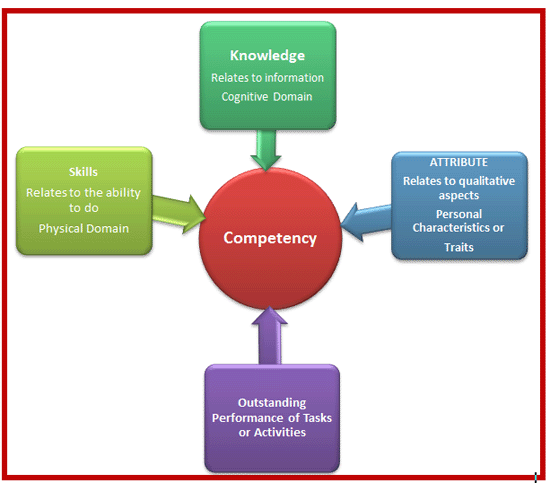
There has been a lot of debate on the aspect that whether competencies are unique to a particular job or they are generic in nature. A little example would help the understanding, does ‘Management’ require the same set of behaviors to be demonstrated across the organization, job function, location etc by the managers or they differ across organizations, cultures, functions and settings
According to the MCBer research apart from identifying 12 characteristics related to managerial effectiveness, seven were found to be threshold competencies.
It is worth to spare a few minutes understanding what a threshold competency is:
It is summarized as a quality that a person needs in order to do a job; it might be as simple as being able to speak in the native language. It is different from the competency in a manner that it does not offer any aid in distinguishing superior performance from average and poor performance.
So, every job at any level in the organization would have a threshold competency, the bare minimum required to perform the job.
To gather a better understanding of competencies, it would be interesting to have a look at the work of some of the pioneers of the field. To begin one can always resort to the exemplary work done by McBer and the competency dictionary developed by him. Some of the generic competencies that were included in the list were:
- Achievement Orientation
- Analytical Thinking
- Conceptual Thinking
- Customer Service Orientation
- Developing Others
- Defectiveness
- Flexibility
- Impact and Influence
- Information Seeking
- Initiative Integrity
- Interpersonal Understanding
There are several more, but looking at the above list, one can notice that these competencies are applicable across businesses and functions and hence called generic competencies.
The above leads to an obvious conclusion that there might be specific types of competencies as well, and surely competencies are also categorized into:
Leadership Competencies: Are managerial and cognitive competencies. E.g. analysis and problem solving, managing execution, adapt and learn etc.
Functional Competencies: Are those which are required within specific functions. E.g. knowledge of products, labor laws, inventory distribution systems, local food safety and handling regulations
The development of a competence is quite a comprehensive job involving several steps. It would be interesting to have a look at the basic structure regarding the development of a competence as given by Training Enterprise and Education Directorate of the UK Employment Department
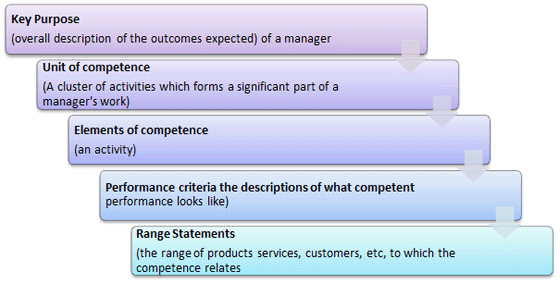
So, with competencies becoming an integral part of Human Resource Management, it has helped the HR practitioners to create and share the understanding of factors leading to superior performance at the workplace. For the job incumbents, it creates a better understanding of their own roles and desired performance which in turn helps them to plan their own learning and growth.