





The Opportunity Canvas Analysis is a Framework or a Model for Entrepreneurs created by the famous management expert and bestselling author, James Green.
In his book by the same name, Green describes how entrepreneurs can anticipate market demand for a new product, determine the market conditions and the industry characteristics, and then motivate themselves to launch new products that would meet the unmet demand for the new product thus identified.
Indeed, Green’s framework is an invaluable guide to Entrepreneurs in understanding how demand for new product arises, how they can analyze the industry and the competition through a rigorous application of theory to practice, and then create value for consumers through innovation and constant upgrading of their products to meet changing market demand as well as to sense and intuit changing consumer preferences according to the real time market movements.
Green starts off by describing the Entrepreneurial Mindset along with mentioning how Entrepreneurs can motivate themselves and in turn, examines how these aspects determine their behaviour.
Indeed, as he mentions, the desire to launch a new product is very different from actually launching it as is the fact that anticipating market demand is vastly different from taking steps to meet such unmet demand.
In other words, while many people do have brilliant ideas that they think can make them launch new ventures and become Millionaires and successful entrepreneurs, only a few do so and among them, a tiny minority succeed in becoming successful. It is in this context that Green’s template for seeing and thinking entrepreneurially as well as acting entrepreneurially is important steps on the road to success for potential entrepreneurs.
(Source: http://opportunityanalysiscanvas.com/)
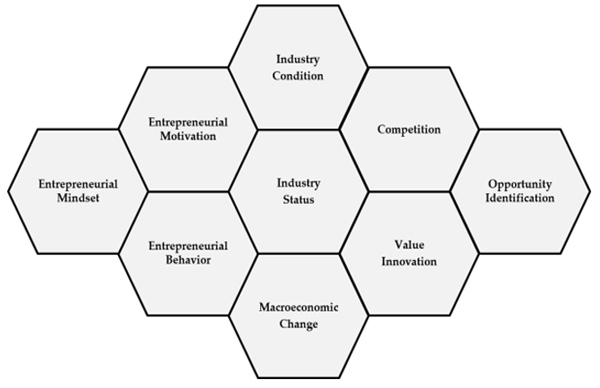
The figure given above is a diagrammatic representation of how the Nine Step framework for seeing, thinking, and acting entrepreneurially actualizes in practice. For instance, “The opportunity Analysis Canvas is structured as a nine-step experience segmented into thinking entrepreneurially with an entrepreneurial mindset, entrepreneurial motivation, and entrepreneurial behavior; seeing entrepreneurially with industry condition, industry status, macroeconomic change, and competition; and acting entrepreneurially with value innovation and opportunity identification. This is the basis of Dr. James V. Green’s research and teaching at the University of Maryland since 2004” (Source: http://opportunityanalysiscanvas.com/).
In other words, the Opportunity Canvas Analysis model is all about anticipating market demand that is unmet by seeing opportunities from an entrepreneurial perspective, thinking about the existing market demand and analyzing the industry status and the competition as well as determining how macroeconomic changes and psychographic changes in consumer behavior affect the new product by thinking entrepreneurially, and then acting on the analysis by launching a new product that would create value for consumers by innovation and forward thinking.
As the website explains, “The Opportunity Analysis Canvas distills vast amounts of research in psychology, sociology, and business into a practical how-to guide for aspiring and active entrepreneurs. Dr. James V. Green presents a whole new understanding of entrepreneurial mindset and action. At its core, The Opportunity Analysis Canvas contains a powerful argument that anyone can be a successful entrepreneur by thoughtfully examining themselves and the business opportunity. By harnessing these insights, we can transform our ideas into businesses that are lasting successes” (Source: http://opportunityanalysiscanvas.com/).
To apply Green’s framework to the real world, supposing you are an entrepreneur and you want to start a new venture.
First, you scan the market for different products and then arrive at a specific product that would satisfy your conditions.
For instance, you want to launch an educational app that connects teachers, students, and parents.
You do have a great idea but are unsure as to how to proceed further. Green’s model can help you here wherein you take a piece of paper and a pen or your Notebook or iPad and then start with determining the present conditions in the market.
This would give you a rough idea of where you stand with respect to the competition and vis-a-vis the existing structures.
After that, you begin to understand the realistic chances of succeeding in the market given your investments and how much the industry needs for a product to be viable. You can also refer to the model wherein the various aspects of advertising and marketing expenses are analyzed and the template for doing so exists in the book written by Dr. Green.
Once your analysis is complete, wherein you have not only seen new demand in an entrepreneurial manner, but you have also considered how to think in terms of the industry characteristics and where you can fit in the overall scheme of things.
The third step is perhaps the most important as until now, you have been theorizing and this is the time to put the plan in place and act upon it. To do so, you need to understand how to differentiate yourself from the competition and how to leverage your investments and capitalize on the market changes.
For this to happen, your product must create value in a manner that existing products in the market have been unable to do so. Thus, you can now launch your product by identifying what and how you would create value and Green also mentions how launching a product is not the end point and rather, constant innovation and invention is the key to success.
Indeed, acting entrepreneurially means that as you innovate continuously, you also identify new market niches and capitalize on them. By this time, you are a fully-fledged entrepreneur who is seeing, thinking, and acting entrepreneurially.
In addition, Green’s model also teaches potential game changers on how to constantly innovate and improve leading to a cyclic process wherein each step feeds into the other, and each iteration of the model results in more success for the entrepreneur.