The costing module is one of the important controlling modules which enables effective internal cost control and accounting. All functionalities regarding cost analysis and cost allocations are provided by this module. The cost accounting module is highly integrated with budget and general ledger modules as well as draws input and provides output to various logistics modules such as sales, procurement, warehousing, shop floor and bill of materials.
Cost Accounting module: Cost accounting module consists of following functionalities:
Overhead Cost controlling.
Cost price calculation.
Hours accounting.
Activity based costing.
Overhead Cost controlling: Overhead cost, which is an indirect cost, can not be directly assigned to the products manufactured or services rendered. Sometime, overhead cost is a significant percentage of overall cost. This functionality helps in defining allocation relations in the form of surcharge/rate applicable to various cost centers which in turn is comparable to budgeted surcharge/ rates. The overhead cost control thus helps to monitor and allocate of indirect cost.
Cost price calculation: Under cost price calculation functionality, simulation (such as to make or subcontract), and calculation of price for standard and customized items are performed. This functionality is crucial in determining the lowest price limit for which a product is profitable. The cost price for standard item is calculated based on the following:
Material cost: Which may be latest procurement price or simulated purchase price.
Operation cost which may consist of labor and machining cost.
Subcontracting rate.
Surcharges for coverage of overhead such as management cost/inspection cost.
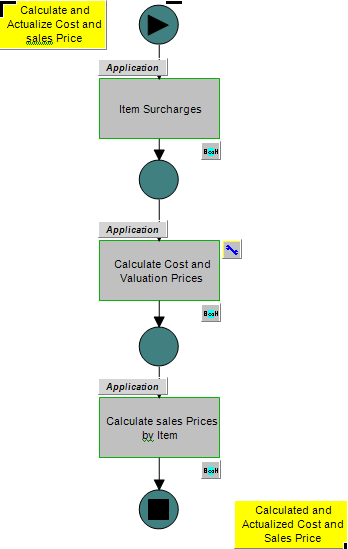
For calculation of cost price for customized items, project specific rates and surcharges are applicable. Cost price calculation also forms basis of calculation of valuation price (where a surcharge is added such as warehouse transfer surcharge) which in turn is used for internal financial transactions such as inventory transfer, Work in progress inventory. Sales price or suggested retail price where a sales price surcharge is added to cost price is also derived from this functionality.
A typical flow chart for calculation of cost and sales price is as follows:
Hours Accounting: This functionality is used to account for employees and machine cost and charge these costs to appropriate production orders. Hours spent can either be entered directly or the system can automatically back flush an estimated hour, on completion of an operation. When hours are posted, financial transactions are created in general ledger. Hours accounting is normally done through a working timetable and normal and overtime rates can be defined in the system. It is also possible to enter estimated/budgeted number of working hour for an employee or a work centre for a particular period (such as month/year) and compare the estimated/budgeted hours with actual hours.
Activity based costing: This is an extension of traditional system of distribution of overhead allocation, where only a few allocation bases are used. This functionality helps in controlling cost objects (which may be anything like products, services, projects, distribution channel) with their cost drivers, through a bill of activities and activity results. Thus, this functionality determines the consumption of business process by products, customers and other cost objects based on the cost drivers and helps in monitoring and controlling cross departmental business process.
Himanshu Juneja, the founder of Management Study Guide (MSG), is a commerce graduate from Delhi University and an MBA holder from the esteemed Institute of Management Technology (IMT). He has always been someone deeply rooted in academic excellence and driven by a relentless desire to create value. Recently, he was honored with the “Most Aspiring Entrepreneur and Management Coach of 2025 (Blindwink Awards 2025)” award, a testament to his hard work, vision, and the value MSG continues to deliver to the global community.
Himanshu Juneja, the founder of Management Study Guide (MSG), is a commerce graduate from Delhi University and an MBA holder from the esteemed Institute of Management Technology (IMT). He has always been someone deeply rooted in academic excellence and driven by a relentless desire to create value. Recently, he was honored with the “Most Aspiring Entrepreneur and Management Coach of 2025 (Blindwink Awards 2025)” award, a testament to his hard work, vision, and the value MSG continues to deliver to the global community.
Himanshu Juneja, the founder of Management Study Guide (MSG), is a commerce graduate from Delhi University and an MBA holder from the esteemed Institute of Management Technology (IMT). He has always been someone deeply rooted in academic excellence and driven by a relentless desire to create value. Recently, he was honored with the “Most Aspiring Entrepreneur and Management Coach of 2025 (Blindwink Awards 2025)” award, a testament to his hard work, vision, and the value MSG continues to deliver to the global community.
Leave a reply
Your email address will not be published. Required fields are marked *