





Fred E. Fiedler’s contingency theory of leadership effectiveness was based on studies of a wide range of group effectiveness, and concentrated on the relationship between leadership and organizational performance.
This is one of the earliest situation-contingent leadership theories given by Fiedler. According to him, if an organization attempts to achieve group effectiveness through leadership, then there is a need to assess the leader according to an underlying trait, assess the situation faced by the leader, and construct a proper match between the two.
Leader’s trait
In order to assess the attitudes of the leader, Fiedler developed the ‘least preferred co-worker’ (LPC) scale in which the leaders are asked about the person with whom they least like to work.
The scale is a questionnaire consisting of 16 items used to reflect a leader’s underlying disposition toward others. The items in the LPC scale are pleasant/unpleasant, friendly/unfriendly, rejecting/accepting, unenthusiastic/enthusiastic, tense/relaxed, cold/warm, helpful/frustrating, cooperative/uncooperative, supportive/hostile, quarrelsome/harmonious, efficient/inefficient, gloomy/cheerful, distant/close, boring/interesting, self-assured/hesitant, open/guarded.
Each item in the scale is given a single ranking of between one and eight points, with eight points indicating the most favorable rating.
| Friendly |
|
Unfriendly | |||||||
| 8 | 7 | 6 | 5 | 4 | 3 | 2 | 1 | ||
Fiedler states that leaders with high LPC scores are relationship-oriented and the ones with low scores are task-oriented. The high LPC score leaders derived most satisfaction from interpersonal relationships and therefore evaluate their least preferred co-workers in fairly favorable terms. These leaders think about the task accomplishment only after the relationship need is well satisfied.
On the other hand, the low LPC score leaders derived satisfaction from performance of the task and attainment of objectives and only after tasks have been accomplished, these leaders work on establishing good social and interpersonal relationships.
Situational factor
According to Fiedler, a leader’s behavior is dependent upon the favorability of the leadership situation. Three factors work together to determine how favorable a situation is to a leader. These are:
- Leader-member relations – The degree to which the leaders is trusted and liked by the group members, and the willingness of the group members to follow the leader’s guidance
- Task structure – The degree to which the group’s task has been described as structured or unstructured, has been clearly defined and the extent to which it can be carried out by detailed instructions
- Position power – The power of the leader by virtue of the organizational position and the degree to which the leader can exercise authority on group members in order to comply with and accept his direction and leadership
With the help of these three variables, eight combinations of group-task situations were constructed by Fiedler. These combinations were used to identify the style of the leader.
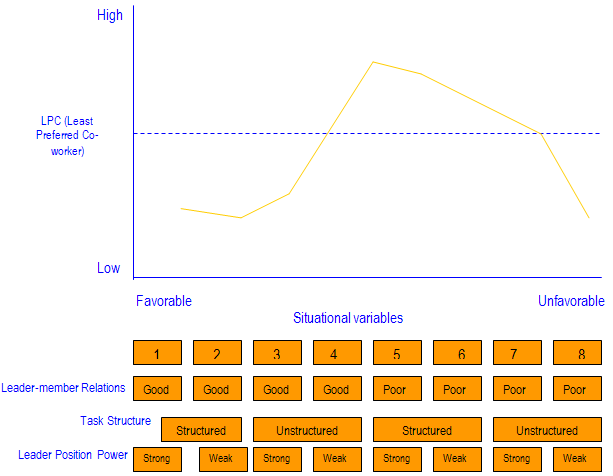 Figure 1: Correlation between leader’s LPC scores and group effectiveness
Leadership Effectiveness
The leader’s effectiveness is determined by the interaction of the leader’s style of behavior and the favorableness of the situational characteristics. The most favorable situation is when leader-member relations are good, the task is highly structured, and the leader has a strong position power.
Research on the contingency model has shown that task-oriented leaders are more effective in highly favorable (1, 2, 3) and highly unfavorable situation (7, 8), whereas relationship-oriented leaders are more effective in situations of intermediate favorableness (4, 5, 6).
Fiedler also suggested that leaders may act differently in different situations. Relationship-oriented leaders generally display task-oriented behaviors under highly favorable situations and display relationship-oriented behaviors under unfavorable intermediate favorable situations.
Similarly, task-oriented leaders frequently display task-oriented in unfavorable or intermediate favorable situations but display relationship-oriented behaviors in favorable situations.