





International trade is shaped and controlled by each country’s foreign trade policy, its import and export regulations, its schedule of customs duties and its trade laws. The body that puts all of this into practice at the border is the customs department.
The customs department is the government agency responsible for implementing import and export policy, valuing goods, collecting customs duties and facilitating the movement of people and cargo into and out of the country.
Where Customs Operates and What Powers It Has
Customs offices are present at every point of entry and exit, including airports, seaports, land border posts and inland container depots.
Customs officials enjoy powers similar to those of the police. They can inspect goods, confiscate illegal items and arrest offenders. They work closely with border security forces, police and intelligence agencies.
Customs covers two broad channels of movement:
- Cargo: Business imports and exports moved by road, sea or air. This is where most duty revenue comes from.
- Personal baggage: Travelers’ belongings. The revenue is small, but baggage is checked to stop narcotics, illegal weapons, undeclared cash and other prohibited goods.
Customs and Trade Policy
Every country publishes a foreign trade policy that sets the conditions under which goods and services may be imported or exported. Customs enforces this policy through its rules, regulations and tariffs.
Under most trade policies, goods fall into three groups:
| Category | What It Means | Examples |
|---|---|---|
| Freely importable | Only normal clearance and duty payment are needed | Most raw materials, machinery and consumer goods |
| Restricted | A specific license or agency approval is needed | Alcohol, animals and animal products, firearms, meat, dairy, plants, poultry, petroleum products |
| Prohibited | Cannot be imported at all | Internationally banned items such as ivory, certain hazardous materials, protected antiques and cultural property |
Restricted goods must also be cleared by the agency responsible for them. In the United States, for example, these include the Food and Drug Administration, the Animal and Plant Health Inspection Service, the Fish and Wildlife Service, and the Bureau of Alcohol, Tobacco, Firearms and Explosives. Most countries have similar specialist agencies. Their tests and approvals must be completed before customs can release the goods.
All goods entering the country must be cleared by customs. This applies to personal effects as well as imports by businesses and even government and defense agencies.
Customs Bonded Warehouses
All import and export cargo is deposited in a customs bonded area until formalities are complete. This is a customs-notified zone where the goods remain under customs control. Nothing can be moved in or out without customs permission.
Bonded warehouses are usually run by customs at airports and seaports. At large ports, the government may set up a separate agency to operate them. Some countries also license customs brokers to run bonded warehouses for exports.
Bonded warehouses serve exporters and importers differently:
- Exporters: Small lots are brought to the bonded warehouse, inspected and then packed into shipping containers. A full container load is often packed at the exporter’s premises and then brought to the port’s bonded area for clearance.
- Importers: Cargo can be stored in bond for a set period without paying duty. The importer can clear it in parts as needed and pay duty only on the portion released. Goods can even be sold to a third party while still in bond, which is known as a high-sea sale.
Until the importer files for home consumption and pays duty, the goods are not legally considered imported. The warehouse charges normal rent and handling fees, and customs may charge interest on the duty if goods stay beyond an allowed period.
The Customs Clearance Process
Customs clearance checks two things: that the goods are what they claim to be, and that they are valued correctly.
Customs compares the commercial invoice with international market prices, confirms the correct tariff classification, and calculates the duty. Once the importer pays, the goods are released.
The process can take from one day to about a week. Most countries allow a free storage period, often around three days for air cargo and up to seven days for sea cargo, though this varies by country and port. After that, demurrage (a daily storage penalty) is charged, which can become expensive.
The Clearance Agent’s Step-by-Step Workflow
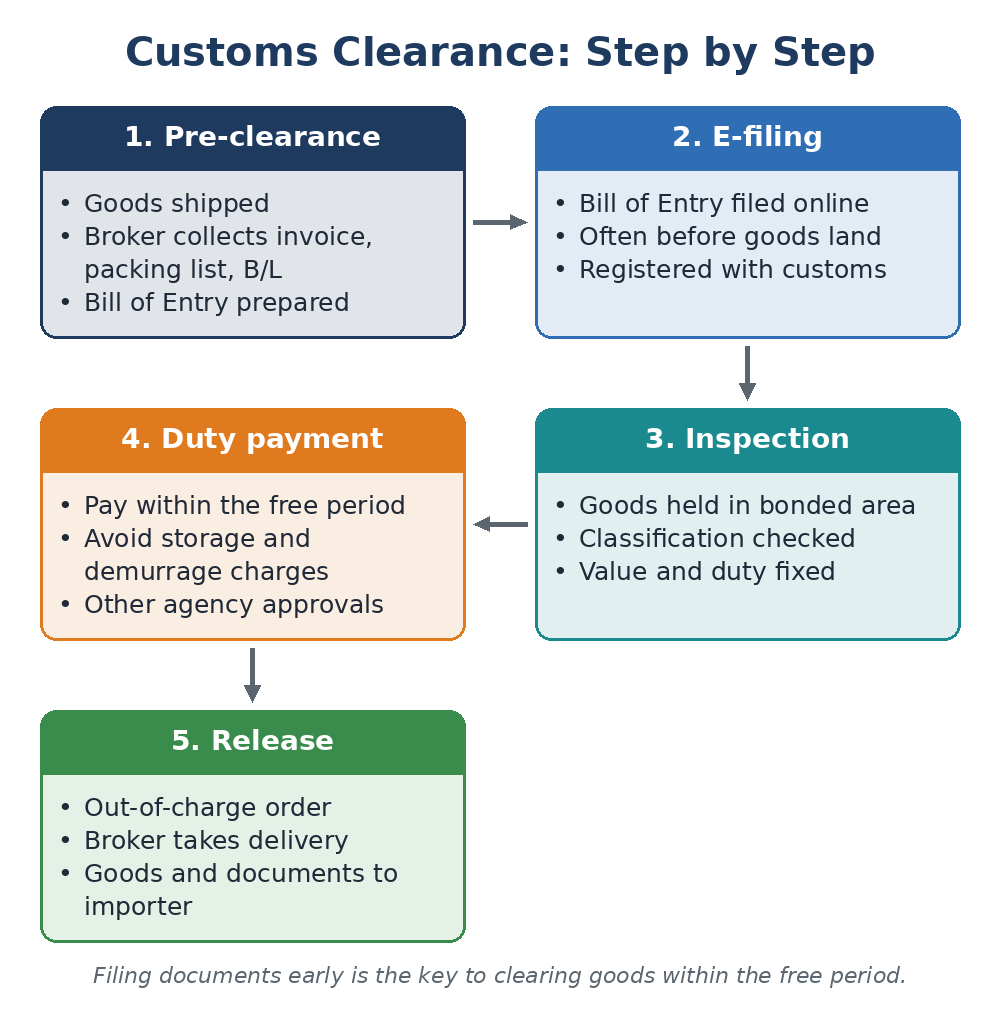
With standardized Incoterms and documents, a clearance agent follows a clear sequence, starting before the cargo arrives:
- Pre-clearance preparation: As soon as the goods are shipped, the agent collects documents from the importer and the forwarder and prepares the Bill of Entry.
- Electronic pre-filing: The Bill of Entry and supporting documents are filed online with customs, often before the goods land.
- Inspection and valuation: On arrival, customs inspects the goods, confirms the classification, checks for under-invoicing and fixes the duty.
- Duty payment: The agent helps the importer pay duty within the free period to avoid port storage charges and container demurrage.
- Delivery: The agent takes delivery from customs and hands the goods and original documents to the importer.
Because the paperwork is largely settled before arrival, most shipments clear within the free period.
Who Handles Clearance: Customs Brokers
Most importers and exporters use a customs broker (also called a clearing agent). Many freight forwarders also offer this service, known as customs brokerage.
Brokers are licensed by customs. To get a license, a person must usually pass a customs examination and know customs laws and procedures thoroughly. In India, brokers were earlier known as Customs House Agents. Brokers act only as third-party representatives of their clients.
Their work includes preparing and filing documents, representing clients during inspection, arranging duty payment and taking delivery of the cargo. Most brokers are linked to customs through electronic data interchange (EDI) systems.
Key Documents for Customs Clearance
The right documents, correct information and timely filing decide how fast goods clear. Missing or wrong documents cause delays, demurrage and lost business.
The main documents and their roles are:
- Commercial invoice: This is the most important document. Customs can question the invoice if it suspects under-valuation to avoid duty.
- Packing list: Every package must carry shipping marks. The list records the number of packages, their size, gross and net weight, and the units in each.
- Certificate of origin: It allows lower duties under bilateral and multilateral trade agreements. It also stops goods from third countries being routed through member countries to dodge duties or quotas.
- Bill of lading and airway bill: The bill of lading is a transport document issued by the shipping line. An “on board” bill of lading confirms that goods are loaded on the ship and is often needed for payment. The airway bill is the airline’s equivalent, and road carriers issue a way bill.
- Bill of entry and shipping bill: These are the formal declarations to customs, the bill of entry for imports and the shipping bill for exports. Customs assesses and releases goods based on them.
- Purchase order: The buyer’s order supports the invoice and confirms the terms of the deal.
- Licenses and permits: These are needed for restricted goods and show that other agencies’ rules have been met. Banks, letter of credit terms or the buyer may also ask for extra documents.
Brokers prepare the shipping bill themselves. This involves classifying the cargo under the correct tariff heading, which is one of the most critical steps in the whole process.
Types of Bills of Entry
The Bill of Entry is the key import document. Customs approves clearance based on it, and the importer needs it later to claim duty credits and for audits.
In India, there are three main types, each printed in a different color:
| Type | Color | When It Is Used | Duty Payment |
|---|---|---|---|
| For home consumption | White | Importer wants to clear the goods and use them right away | Paid at clearance |
| For warehousing (into bond) | Yellow | Importer wants to store goods in a bonded warehouse and clear later | Deferred; importer signs a bond instead |
| Ex-bond | Green | Importer clears some or all warehoused goods | Paid at the rate in force on the day of removal |
Note that under an ex-bond Bill of Entry, duty is charged at the rate in force when the goods leave the warehouse, not the rate assessed when they entered. If the tariff has changed in between, the new rate applies.
The Revenue Intelligence Role of Customs
Customs also has a revenue intelligence wing. It looks for under-valuation, under-invoicing and transfer-pricing tricks used to evade duty.
It keeps a database of international prices for key commodities and tracks market trends, which helps it spot suspiciously low invoice values. It also works with border forces and intelligence agencies to stop smuggling and illegal entry.
Practical Tips for Importers
First-time importers can avoid most delays, and the storage and demurrage charges that come with them, by following these steps:
- Check the tariff code before you order. Find the Harmonized System (HS) code for your product before placing the overseas order. It tells you the duty rate and whether any special permit is needed.
- Make sure the documents match. The commercial invoice, packing list and bill of lading (or air waybill) must show exactly the same descriptions, weights and values. Mismatches are a leading cause of inspections and delays.
- Brief your broker early. Send copies of all documents to your customs broker as soon as the goods are shipped, so the bill of entry can be filed before the cargo arrives.
- Arrange duty funds in advance. Keep the estimated duty ready in your payment account a day or two before arrival, so the goods can be released within the free storage period.
- Use bonded warehousing if you need the goods in stages. Duty is then paid only on the quantity taken out each time.
Frequently Asked Questions
What does the customs department do?
It enforces import and export rules, values goods, collects customs duties and prevents smuggling at airports, seaports and land borders.
What is customs clearance?
It is the process of getting customs approval to bring goods into or send goods out of a country, including inspection, valuation and duty payment.
What is a Bill of Entry?
It is the importer’s formal declaration to customs describing the imported goods and their value. Customs assesses and releases goods based on it.
What is demurrage in customs clearance?
It is a daily charge for keeping goods at the port or warehouse beyond the free period. Timely documents and payment help avoid it.
Who is a customs broker?
A customs broker is a licensed agent who handles documentation and clearance with customs on behalf of importers and exporters.