





Walk into two offices with the same pay scales and the same products, and you can often feel the difference within minutes. In one, people take initiative, help each other and talk about their work with energy. In the other, people wait for instructions, watch the clock and grumble about management. The difference is engagement.
The level of employee engagement can be measured by employees’ willingness and ability to contribute to their organization’s success. Their discretionary effort, the extra effort they choose to give beyond the minimum, is essential to the health and well-being of any company.
This article describes the characteristics of an engaged workforce, the three types of employees based on their level of engagement and what managers can do to move more people into the engaged group.
Why an Engaged Workforce Matters
A highly engaged workforce is always keen to take on new challenges to bring positive change and create a productive work environment. Many studies have shown that higher engagement is linked to higher employee satisfaction, greater productivity and profitability, and more satisfied and loyal customers.
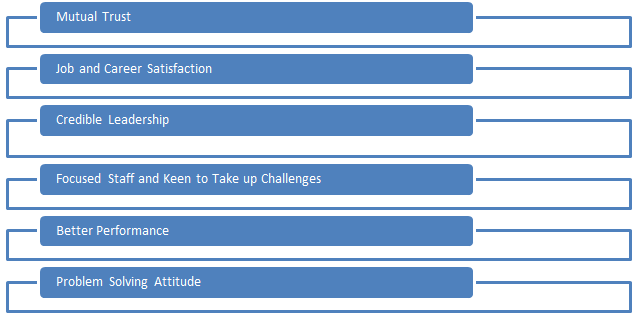
Characteristics of an Engaged Workforce
-
Mutual trust
Trust is the foundation of any organization. Letting people do their work without telling them exactly how is one of the best ways to engage them. In an engaged workforce, employees welcome each other’s opinions and find many different ways to complete a task. They do not need directions at every step. They get the job done through mutual help and trust.
-
Job and career satisfaction
Job satisfaction is a defining feature of an engaged workforce. People who are happy with their careers and the way they are progressing tend to stay with the organization for a long time. Satisfied employees rarely switch jobs.
-
Leadership at every level
An engaged workforce does not need constant direction. Employees know how to do their jobs well. They show credible leadership qualities in routine tasks and come up with innovative ways to handle crises and emergencies.
-
Focus and eagerness to take on challenges
Engaged employees are focused and know what to do and when. They are eager to take on new challenges, solve existing problems, learn new skills and widen their horizons.
-
Better performance
Engagement is directly linked to better performance. Performance is one of the clearest signs of how engaged, involved and dedicated employees are. If engagement does not show up in performance, the workforce is not truly engaged.
-
A problem-solving attitude
An engaged workforce does more than deliver on its responsibilities. It keeps a problem-solving mindset. Engaged employees feel a sense of belonging and make every effort to remove obstacles to the organization’s success.
Other traits
Engaged employees also tend to show mutual respect, commitment, enthusiasm, optimism and extra effort to serve customers better.
Types of Employees Based on Their Level of Engagement
An organization is a group of people working toward a common goal. For it to flourish, employees need to work at their full potential, which unfortunately is not the case in most organizations. People may not connect with the company’s goals, may have problems with their team, manager or subordinates, or may simply have a negative attitude.
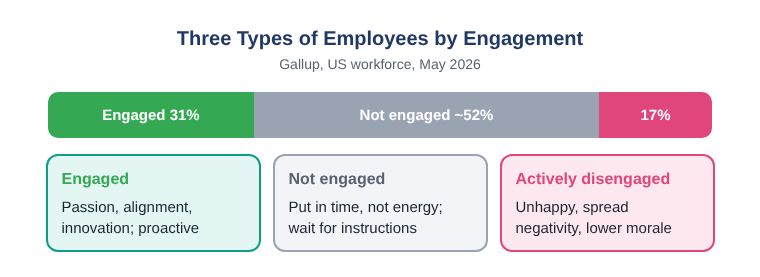
This led to the widely used classification of employees into three groups based on their level of engagement and commitment. The diagram shows the three groups.
-
Engaged employees
Engaged employees can be described in three words: passion, alignment and innovation. They are passionate about their work, connected to the company’s goals and keen to innovate. They contribute new ideas and turn them into reality. They are positive and spread positivity. They are proactive, anticipating what their work and customers will need and dealing with small problems before they grow.
-
Not engaged employees
These employees make up the largest group in most organizations. They do what they are told, and they prefer one instruction at a time. They put in time, but not energy or passion. Their outlook toward the organization may be positive or negative. They are not proactive and rarely anticipate what will be needed next. Instead, they wait for instructions from their managers.
-
Actively disengaged employees
These employees are unhappy, and they spread their unhappiness. They can become sources of negativity in the company, spreading complaints and even encouraging others to leave. Yet they often stay a long time themselves, and some try to get ahead by undermining colleagues rather than performing well.
Feature Engaged Not engaged Actively disengaged Attitude Passionate and positive Neutral, going through the motions Unhappy and negative Effort Gives discretionary effort Puts in time, not energy Does the minimum or less Initiative Proactive, anticipates needs Waits for instructions Resists or undermines Ideas Contributes and implements ideas Rarely contributes Criticizes others’ ideas Effect on team Spreads energy Little effect Lowers morale Likelihood to leave Low Moderate Often stays despite unhappiness
How Common is Each Type?
Gallup, which popularized this classification, tracks engagement every year. As of May 2026, Gallup found that 31% of US employees were engaged and 17% were actively disengaged, which leaves roughly 52% not engaged. Globally, the picture is weaker: Gallup reported that only 21% of employees worldwide were engaged in 2024.
Figures vary by country, industry and organization, but the pattern is consistent: in most workplaces, the “not engaged” middle group is the largest.
Why the Mix Matters
The proportion of employees in each group is a good indicator of an organization’s health. Engaged employees are more efficient and deliver better results. They understand the business better, focus more on clients and are committed to growing with the organization.
A large share of actively disengaged employees means bigger losses in productivity, lower morale and a weaker bottom line.
How to Move Employees Toward Engagement
| From | To | What helps |
|---|---|---|
| Not engaged | Engaged | Meaningful work, clear goals, recognition, growth opportunities |
| Actively disengaged | Not engaged or engaged | One-on-one conversations to uncover the cause, fixing real grievances, a better role fit |
| Engaged | Staying engaged | Autonomy, new challenges, trust, career progress |
Practical steps for managers:
- Talk to people individually. Ask what energizes them and what frustrates them.
- Connect work to purpose. Show each person how their job contributes to the bigger goals.
- Recognize effort quickly and specifically.
- Give autonomy and trust. Let people decide how to do their work.
- Address problems early. Deal with grievances and poor behavior before they spread.
- Measure regularly. Use engagement and pulse surveys to track progress.
Conclusion
An engaged workforce is marked by mutual trust, job satisfaction, leadership at every level, focus, strong performance and a problem-solving attitude. Employees can be grouped into three types: engaged, not engaged and actively disengaged. In most organizations, the middle group is the largest, which means there is a big opportunity. By connecting work to purpose, recognizing effort, building trust and addressing problems early, managers can move more people into the engaged group and build a healthier, more productive organization.
Frequently Asked Questions
What are the characteristics of an engaged workforce?
Mutual trust, job and career satisfaction, leadership at every level, focus and eagerness for challenges, better performance and a problem-solving attitude.
What are the three types of employees based on engagement?
Engaged, not engaged and actively disengaged.
What percentage of employees are engaged?
According to Gallup, 31% of US employees were engaged as of May 2026, and 21% of employees were engaged globally in 2024.
Who are actively disengaged employees?
They are unhappy at work and spread negativity, often undermining colleagues and lowering team morale.
How can managers engage “not engaged” employees?
By giving them meaningful work, clear goals, recognition, growth opportunities and regular conversations about what motivates them.