





Sponsorship is one of the most important sources of income for sports leagues and events, often second only to the sale of media rights. Companies pay to be associated with a league, tournament or team, and in return gain access to a large, passionate audience that is hard to reach through ordinary advertising.
Major events cost so much to stage that no single sponsor could pay for them. So most large leagues and tournaments sell sponsorship rights to many companies at different levels, with different prices and benefits. This is called level-based or tiered sponsorship.
The FIFA World Cup shows the scale involved: FIFA reported that around 1.5 billion people engaged with coverage of the 2022 final. Being associated with such an event can transform a brand’s profile, which is why sponsors are willing to pay heavily for the top tiers.
This article explains what sports league sponsorship is, how tiered sponsorship works, its benefits and issues, and how leagues plan their sponsorship programs.
What Are Sports League Sponsorships?
There is no single definition, but a sports sponsorship is an agreement in which a company provides resources to a sports property in return for the right to use its name, logo and audience for commercial purposes. The resources may be cash, products or services provided free of charge (for example, a sportswear brand supplying kits).
Sponsorship was once seen partly as patronage. Today it is a commercial marketing activity with clear financial goals, measured using recall surveys, media exposure tracking and sales analysis. This commercial purpose distinguishes it from a company’s charitable activities.
What Is Level-Based (Tiered) Sponsorship?
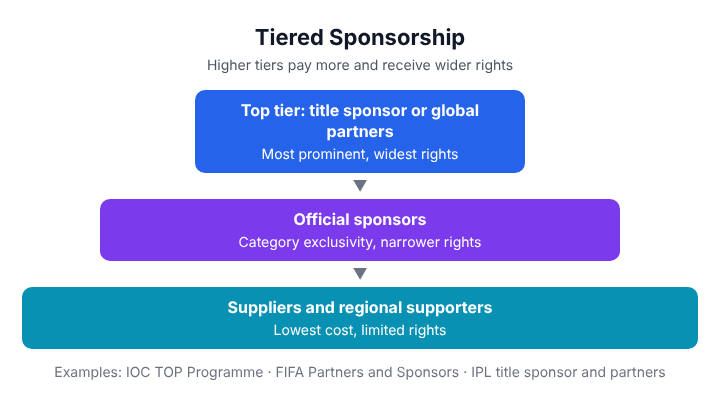
Instead of selling all its commercial rights to one company, the league divides them into packages and sells each package to a different sponsor. Higher tiers cost more and receive more prominent and wider rights; lower tiers cost less and receive narrower rights.
| Event | Tier Structure |
|---|---|
| Olympic Games | The IOC’s TOP Programme of worldwide partners, plus national organizing committee sponsors and suppliers |
| FIFA World Cup | FIFA Partners, FIFA World Cup Sponsors and Regional Supporters |
| Indian Premier League | A title sponsor (the league is named after it), followed by official and associate partners |
The Olympic model is the classic example. The International Olympic Committee (IOC) created The Olympic Partner (TOP) Programme in 1985. It gives a small group of worldwide partners exclusive rights in their product category across every national Olympic committee and every edition of the Games, while each host city’s organizing committee sells its own, lower tiers of national sponsors and suppliers.
The league must design the packages so that each sponsor’s benefits are clear and do not overshadow the others.
When Does Tiered Sponsorship Work?
Not every event suits a tiered approach. It works best when:
- The event is large and attracts a big audience
- The audience is diverse, so it interests marketers from many different industries
- The league has a large, capable team to manage many sponsors and their rights
For smaller events, a single sponsor may be better for both sides.
Benefits of Tiered Sponsorship
- More money raised: No single company can fund a major event. Selling separate packages lets the league raise far more in total.
- Access for more sponsors: Lower tiers make sponsorship affordable for companies that could never pay for the top level, although they receive fewer rights in return.
- More competition: More potential sponsors competing for packages pushes prices up.
- More publicity: Each sponsor spends its own money promoting its association with the event, which also promotes the league.
Issues With Sponsorship Levels
-
Brand Clutter
When many brands sponsor the same event, each brand’s message is diluted. Fans exposed to many logos at once may remember few of them. For this reason, some brands avoid co-sponsorship, especially for smaller events.
-
Designing Valuable Packages
The league must decide what extra benefits to offer at each level, such as more tickets, hospitality or broadcast exposure. These may not be equally valuable to every sponsor.
-
Maintaining Fairness
Packages are often adjusted during negotiation. The league must make sure that no sponsor receives better value at another’s expense, and that the price of each tier reflects its benefits.
-
Complex Management
Managing many sponsors requires specialist legal, commercial and operational teams. Payment schedules differ, and if one sponsor fails to pay, the whole event and the other sponsors’ investment may be affected.
-
Shared Reputation Risk
Sponsorship transfers image between sponsor and event. With many sponsors, every brand is exposed to the actions of the league and of every other sponsor. A scandal involving one can affect all.
-
Fewer Advertising Opportunities
Sponsorship contracts usually give sponsors exclusivity in their product category. The more categories that are sold to sponsors, the fewer competing companies can buy advertising, which may reduce advertising revenue over time.
-
Ambush Marketing
Companies that are not sponsors may try to associate themselves with the event anyway, through advertising, promotions or giveaways near venues. This undermines the value of official sponsorship. Many host countries pass special laws for major events to prevent it.
| Benefits | Issues |
|---|---|
| More total sponsorship revenue | Brand clutter |
| Affordable entry for more companies | Hard to design packages of equal value |
| Competition raises prices | Complex to manage |
| Extra publicity from sponsors | Shared reputation risk |
| Wider reach for the league | Fewer advertising opportunities; ambush marketing |
Planning a Sports Sponsorship Program
- Forecasting and scheduling: The league must reliably estimate audiences, both in the stadium and on screens, and schedule key matches at times that maximize viewing. Bigger, more predictable audiences command higher sponsorship fees.
- Choosing the sponsorship mix: The league decides which rights to monetize, such as naming rights, shirts, venues, digital content and hospitality, and how to package them.
- Setting a competitor policy: The league should not take money from a sponsor and its direct competitor in the same category. It must define clearly which companies count as competitors.
- Ensuring pricing parity: Each package should be priced in line with its benefits, so all sponsors feel they are treated fairly. This builds long-term relationships.
A Simple Three-Tier Structure
Many leagues use a three-level structure like the one below. The exact rights and prices vary, but the principle is that each tier is clearly separated from the others, so sponsors know what they are paying for and brand clutter is kept under control.
| Tier | Number of Sponsors | Typical Rights | Relative Price |
|---|---|---|---|
| Title or global partner | One | League named after the sponsor; logo on all league branding and broadcasts | Highest |
| Official partners | A handful, one per category (for example, car, bank, telecom) | Exclusive category rights, stadium boards, digital and social media content | Medium |
| Official suppliers | Several, often non-exclusive | Right to call themselves the official supplier of a product, such as the match ball, plus tickets and hospitality | Lowest |
Defining Competitors Clearly
Category exclusivity is only as strong as the contract’s definition of a competitor. Suppose a carmaker buys the official automotive partnership. Does its exclusivity also cover electric scooters, ride-hailing apps or car-leasing companies? If the contract does not say, the league may sell those categories to other sponsors, and the carmaker may feel its exclusivity has been undermined. Good contracts list the categories and named brands that count as competitors, and say what happens when a sponsor’s business expands into a new area.
Trends in Sports Sponsorship
- Digital rights: Sponsors increasingly want rights to social media, streaming and digital content, not just stadium signage.
- Women’s sport: Rapid growth in audiences for women’s sport has attracted new sponsors at lower cost.
- Data and measurement: Sponsors expect detailed data on audiences and results.
- Purpose-driven partnerships: Many brands link sponsorship to community and sustainability goals.
- Changing categories: Regulation can remove whole sponsor categories, as India’s 2025 online gaming law did for fantasy platforms.
Conclusion
Tiered sponsorship allows leagues and events to raise far more money than any single sponsor could provide, while giving companies of different sizes a way to take part. Its success depends on careful planning: well-designed packages, fair pricing, clear category exclusivity and strong management to protect every sponsor’s investment.
Frequently Asked Questions
What is tiered sponsorship?
It is a system in which a league or event sells sponsorship rights at several levels, such as title sponsor, official partner and supplier, each with a different price and set of benefits.
Why do major events use tiered sponsorship?
Because their costs are too high for one sponsor, and dividing the rights allows them to raise more money from more companies.
What is a title sponsor?
The top-tier sponsor whose name is attached to the event or league, such as the title sponsor of the Indian Premier League.
What is ambush marketing?
It is when a company that is not an official sponsor tries to associate itself with an event, reducing the value paid for by official sponsors.