There are various ways in defining an Enterprise Resource Planning System. This is how it has been defined by American Inventory and Production Control System (APICS) dictionary:
“Enterprise Resource Planning: An accounting oriented information system for identifying and planning the enterprise-wide resources to make, ship and account for customer orders.”
Again in Internet encyclopedia, it has defined as “An enterprise planning system is an integrated computer-based application used to manage internal and external resources, including tangible assets, financial resources, material and human resources”.
Basically, an ERP combines several traditional management functions into a logically integrated system and facilitate the flow of information across these functions. It is designed to model and automate basic processes across the organization over a centralized database and eliminates the need of disparate systems maintained by various units of the organization.
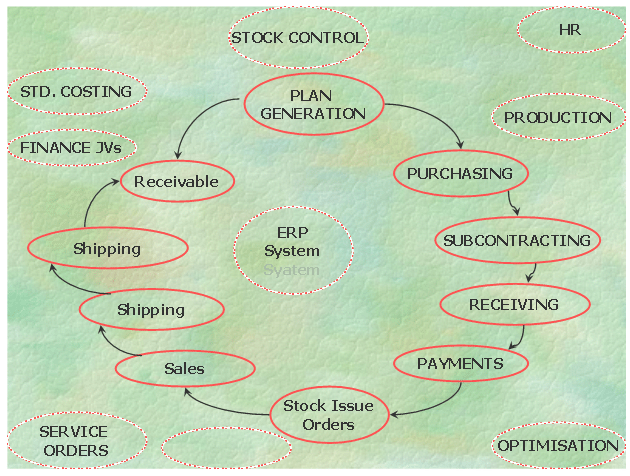
Figure below shows how information is integrated into a typical organization using an ERP system.
ERP system is thus a mirror image of the major business processes of an organization.
Need for Enterprise Resource Planning - Why ERP ?
Separate systems were being maintained during 1960/70 for traditional business functions like Sales Marketing, Finance, Human Resources, Manufacturing, and Supply Chain Management. These systems were often incongruent, hosted in different databases and required batch updates. It was difficult to manage business processes across business functions e.g. procurement to pay and sales to cash functions.
ERP system grew to replace the islands of information by integrating these traditional business functions.
The successful implementation of an ERP system will have many advantages, as indicated below:
Business Integration and Improved Data Accuracy: ERP system is composed of various modules/ submodules where a module represents a particular business component. If data is entered in one module such as receiving, it automatically updates other related modules such as accounts payable and inventory. This updating occurs at real time i.e. at the time a transaction occurs.
Since, data needs to be entered only once at the origin of the transaction, the need for multiple entries of the same data is eliminated.
Likelihood of duplicate/erroneous data is, therefore, minimized. The centralized structure of the database also enables better administration and security provisions, which minimizes loss of sensitive data.
Planning and MIS: The various decision support tools like planning engines and simulations functions, form an integral part of an ERP system that helps in proper utilization of resources like materials, human resources, and tools.
Constrained based planning help in drawing appropriate production schedules, thereby improving the operation of plant and equipment. As a part of MIS, an ERP system, contains many inbuilt standard reports and also a report writer that produce ad hoc reports, as and when needed.
Improved Efficiency and Productivity: In addition to provision of improved planning, ERP system provides a tremendous boost to the efficiency of day to day and routine transactions such as order fulfillment, on time shipment, vendor performance, quality management, invoice reconciliation, sales realization, and cash management. Cycle time is reduced for sales to cash and procurement to pay sequences.
Establishment of Standardized Procedures: ERP system is based on processes of international best practices, which are adopted by the organizations during implementation. Department silos are purged, and maverick practices are done away with. Because of top-down view available to management, chances of theft, fraud and obsolescence are minimized.
Flexibility and technology: Due to the globalized environment, where production units, distribution centers, and corporate offices reside in different countries, organizations need multi-currency, multi-language and multi-accounting modes, in an integrated manner. These provisions are available in most of the ERP systems, particularly in products offered by tier 1 and tier 2 vendors.
ERP vendors are also quick to adopt latest technologies, from mainframe to client server to the internet. Unlike a bespoke system, Upgrading to latest technology for a running ERP system is uncomplicated, involving mostly adoption of service packs and patches.
Conclusion
Although ERP provides many advantages; its implementation is a strategic decision, involving significant resources (both financial and human), proper evaluation and business process re-engineering. There must be a commitment from all levels. A failed implementation may lead to bankruptcy of an organization.
Himanshu Juneja, the founder of Management Study Guide (MSG), is a commerce graduate from Delhi University and an MBA holder from the esteemed Institute of Management Technology (IMT). He has always been someone deeply rooted in academic excellence and driven by a relentless desire to create value. Recently, he was honored with the “Most Aspiring Entrepreneur and Management Coach of 2025 (Blindwink Awards 2025)” award, a testament to his hard work, vision, and the value MSG continues to deliver to the global community.
Himanshu Juneja, the founder of Management Study Guide (MSG), is a commerce graduate from Delhi University and an MBA holder from the esteemed Institute of Management Technology (IMT). He has always been someone deeply rooted in academic excellence and driven by a relentless desire to create value. Recently, he was honored with the “Most Aspiring Entrepreneur and Management Coach of 2025 (Blindwink Awards 2025)” award, a testament to his hard work, vision, and the value MSG continues to deliver to the global community.
Himanshu Juneja, the founder of Management Study Guide (MSG), is a commerce graduate from Delhi University and an MBA holder from the esteemed Institute of Management Technology (IMT). He has always been someone deeply rooted in academic excellence and driven by a relentless desire to create value. Recently, he was honored with the “Most Aspiring Entrepreneur and Management Coach of 2025 (Blindwink Awards 2025)” award, a testament to his hard work, vision, and the value MSG continues to deliver to the global community.
Leave a reply
Your email address will not be published. Required fields are marked *