





Startups usually raise money in one of two ways: debt, which must be repaid with interest, or equity, where investors buy shares. At the earliest stage, both can be awkward. Banks rarely lend to companies with no track record, and pricing equity is hard when the business is little more than an idea.
Convertible notes offer a middle path. They are a hybrid instrument that starts as a loan and later converts into shares. They let founders raise money quickly without agreeing on a valuation, while giving early investors a reward for taking the risk of backing the company first.
Convertible notes are not new. They have been used in startup funding for decades and have contributed to both great successes and painful disputes. Understanding how they work protects both founders and investors.
In this article, we will explain what convertible notes are, how their main terms work, who uses them, and their pros and cons.
What Is a Convertible Note?
A convertible note is a short-term loan from an investor to a startup that is designed to convert into equity later, usually when the company raises its next priced equity round.
At first, the note behaves like debt. It carries an interest rate, but interest is usually not paid in cash. Instead, it accrues and is added to the amount that converts. When the trigger event happens, the principal plus interest converts into shares.
Key Terms of a Convertible Note
- Principal: The amount invested.
- Interest rate: Usually modest, often in the range of 2% to 8% a year, and accrued rather than paid.
- Maturity date: The date by which the note should convert or be repaid, often 18 to 24 months after issue.
- Conversion trigger: Usually a “qualified financing”, meaning a priced equity round above a minimum size. A sale of the company is another common trigger.
- Discount: A reduction on the price paid by new investors, often 10% to 25%, rewarding early risk.
- Valuation cap: The maximum valuation at which the note converts. If the next round is priced above the cap, note holders convert at the cap price instead.
Note holders get whichever is better for them: the discount price or the cap price.
A Worked Example
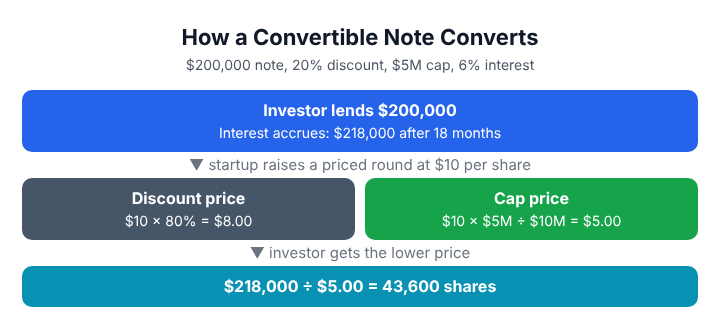
An angel invests $200,000 in a convertible note with a 20% discount, a $5 million valuation cap and 6% interest. Eighteen months later, the startup raises a priced round at $10 per share, based on a $10 million pre-money valuation.
- Amount converting: $200,000 + 18 months of interest (about $18,000) = $218,000
- Discount price: $10 × (1 − 20%) = $8.00 per share
- Cap price: $10 × ($5 million ÷ $10 million) = $5.00 per share
- The investor converts at the lower price, $5.00.
- Shares received: $218,000 ÷ $5.00 = 43,600 shares
Without the cap, the investor would have received only 27,250 shares at $8.00. This shows why the valuation cap protects investors when a company grows fast.
Note or SAFE? Choosing the Right Instrument
Founders raising early money often choose between a convertible note and a SAFE (compared in the table further below).
- A SAFE may suit founders who want the simplest documents and no maturity date, so there is no repayment deadline if the next round is delayed. Y Combinator’s post-money SAFE, introduced in 2018, also makes it easy to see exactly how much of the company each investor will own.
- A convertible note may suit investors who want the protections of debt: interest, a maturity date and a claim ahead of shareholders if the company fails. Notes also fit more easily into company law in some countries, including India, where SAFEs do not have a clear legal status.
Whichever instrument is used, founders should avoid raising several rounds of notes or SAFEs with different valuation caps, for example $4 million, then $6 million, then $8 million. Each cap converts differently, which makes the cap table hard to follow and can produce more dilution than founders expect when the priced round finally arrives. Modeling every conversion in a spreadsheet before signing is the best protection.
Who Issues Convertible Notes?
Convertible notes are most common at the pre-seed and seed stages, when founders need cash but the business is too young to value with confidence. They are also used as bridge financing between two priced rounds.
When many investors hold notes on different terms, the cap table can become complicated at conversion. Clear, consistent agreements help avoid disputes.
Convertible Notes vs. SAFEs vs. Priced Rounds
In 2013, Y Combinator introduced the SAFE (Simple Agreement for Future Equity), which works like a convertible note without interest or a maturity date. 500 Startups later introduced a similar instrument, the KISS.
| Feature | Convertible note | SAFE | Priced equity round |
|---|---|---|---|
| Legal form | Debt that converts | Contract for future equity | Shares issued now |
| Interest | Yes, usually accrued | No | No |
| Maturity date | Yes | No | Not applicable |
| Valuation agreed now | No (cap and discount) | No (cap and discount) | Yes |
| Speed and legal cost | Fast and fairly cheap | Fastest and cheapest | Slower and more expensive |
In India, DPIIT-recognized startups can issue convertible notes of at least Rs 25 lakh in a single tranche, including to foreign investors under the Foreign Exchange Management (Non-debt Instruments) Rules, 2019. The notes must be repaid or converted into shares within 10 years of issue (the limit was originally five years). Founders should take local legal advice, as rules differ by country.
Advantages of Convertible Notes
- Defers valuation: At a very early stage, founders fear underpricing the company and investors fear overpaying. A note puts off the valuation question until there is more evidence.
- Faster and cheaper: Paperwork is simpler than for a priced round, with lower legal costs, which matters for startups with little cash.
- Rewards early investors: The discount and cap let early backers buy shares at a better price than later investors.
- Some downside protection: As debt, a note ranks ahead of shareholders if the company fails, although in practice there is often little left to recover.
- Flexible bridge: Notes can fund a company between rounds without resetting its valuation.
Disadvantages of Convertible Notes
- Repayment risk at maturity: If the startup does not raise a qualified round in time, note holders could demand repayment. A startup without cash could be pushed toward insolvency. In practice, notes are often extended or converted by agreement, but the risk remains.
- Price set by others: The conversion price depends on future investors, not the founders or note holders, so neither side fully controls the outcome.
- Hidden dilution: Founders may underestimate how much of the company they are giving away until conversion, especially with low caps or several notes stacking up.
- Complexity with many notes: Different caps, discounts and dates can create confusion and conflict at conversion.
- Interest adds up: Accrued interest increases the shares issued at conversion.
| Pros | Cons |
|---|---|
| Postpones valuation | Repayment risk if no round is raised |
| Quick and low cost | Conversion price set by later investors |
| Rewards early investors | Dilution can be larger than expected |
| Ranks ahead of equity | Multiple notes create complexity |
| Useful as bridge funding | Accrued interest increases dilution |
Conclusion
Convertible notes can be valuable for both founders and investors. They let startups raise money before a clear valuation exists and give investors a foothold with a reward for early risk. But they carry real risks if no qualified round arrives, and the dilution can surprise founders. Founders should compare notes with SAFEs and priced rounds, model the dilution carefully and choose the option that best fits their stage.
Frequently Asked Questions
What is a convertible note in startup funding?
It is a short-term loan from an investor that converts into shares later, usually when the startup raises a priced equity round.
What is a valuation cap?
It is the maximum valuation at which the note converts into shares. It protects investors by guaranteeing a maximum price per share.
What is a conversion discount?
It is a percentage reduction on the price paid by new investors, given to note holders as a reward for investing early.
What happens if a convertible note reaches maturity without converting?
The investor may ask for repayment, or the parties may agree to extend the note or convert it on agreed terms.
What is the difference between a convertible note and a SAFE?
A SAFE has no interest and no maturity date, so it is not debt. A convertible note is debt that accrues interest and has a maturity date.