Supply Chain and Distribution Requirement Planning
One important function of Enterprise Planning is logistic planning of items which are acquired from elsewhere within the organization. In Enterprise Planning, this type of supply is known as distribution. The distribution volume/quantity are planned in the form of planned distribution orders. Within the master-planning horizon, these planned distribution orders serve as a distribution plan. When a distribution quantity is planned, the related requirement of the item is passed on at the appropriate level of depot/warehouse, so that system can take this dependent demand into account.
Setting up a structure for distribution planning is done by defining clusters and by modeling the goods flow through supply chain by supplying relationships and sourcing strategies.
Clusters: Enterprise Planning uses clusters to model distribution structures within a site and/or between related sites. A cluster is a group of entities such as warehouses/ work centers. A cluster normally represents a geographical location, consisting of one or more warehouses (usually non-nettable warehouses) that are considered as one unit for planning purposes.
Clusters are used to specify groupings of entities so that relationships between entities can be defined. Entities belonging to a cluster do not have to belong to the same financial and/or logistic company of an organization. The notion of a clustered item is comparable to that of an item/warehouse combination under inventory module. The major difference is that a cluster can be an aggregate several warehouses.
The concept of cluster is best illustrated by the following Example. Suppose distribution centers of a large retail organization are grouped into i) north, ii) south iii) east and iv) west clusters. All of them, in addition to getting some local supplies, are largely supplied by distribution orders from a central warehouse.
The distribution requirement planning for north cluster, where supply chain comprises of one regional depot and three divisional depots, are shown in the following diagram:
Cluster and Warehouse Hierarchy
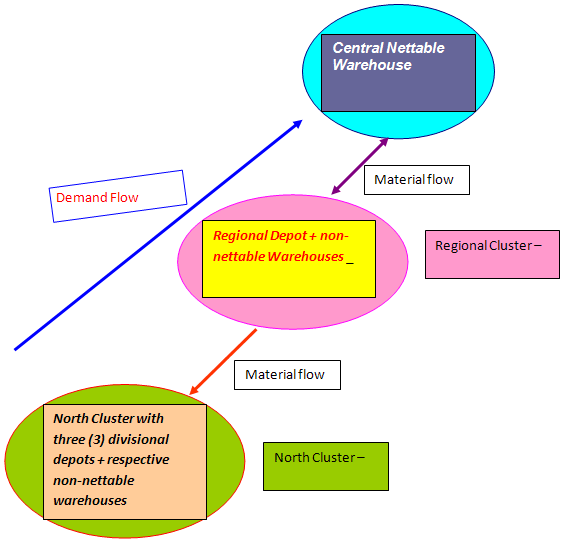
It may be noted that the flow of demand is upward and the flow of goods can be in any direction.
Supply Planning - Supply planning is the next important element of distribution requirement planning, which comprises of following:
Supply Sources
Material requirements can be covered with three types of orders:
- Production orders.
- Distribution orders.
- Purchase orders.
Distribution orders move the goods between clusters. Distribution orders are especially suitable for the situation where depots/ sales channels of an organization are spread throughout a large area.
Goods Flow Strategies
Sources of supply are optimized with:
- Supply chain strategies
- Sourcing strategies
- Supply strategies
The sourcing strategy determines whether a requirement is covered by production orders, distribution orders, or purchase orders. A combination of these sources is also possible. If the source is distribution, the system selects the suppliers (depots) on the basis of
- Supply strategies for internal suppliers.
- Supplying relationships which define extent of aggregation at cluster and item group level.
If the source is purchase, system selects the suppliers on the basis of supply strategy for external suppliers.
Supply Strategy: refers to the method by which the supply of plan items is divided over multiple suppliers. The supply strategy defines the priority rules and allocation rules that direct the planning engines in the choice of suppliers. There are separate supply strategies for external suppliers (planned purchase orders) and for internal suppliers (planned distribution orders)
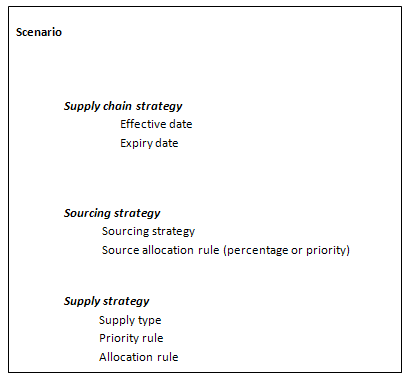
Supply Chain Strategy: The sourcing strategies and supply strategies are grouped in supply chain strategies. Supply chain strategies can be linked to scenarios and remains valid during a certain time period within that scenario. This functionality enables to flexibly change business strategy over time such as percentage of items to make, buy or distribute.
The following figure shows how the concepts are related.
| ❮❮ Previous | Next ❯❯ |
 Related Articles
- Planning Functionality of an ERP System
- Demand Planning & Master Planning
- Order based Planning
- Setting Up Service Module
- ERP Package - Sales Module
Authorship/Referencing - About the Author(s)

The article is Written and Reviewed by Management Study Guide Content Team. MSG Content Team comprises experienced Faculty Member, Professionals and Subject Matter Experts. We are a ISO 2001:2015 Certified Education Provider. To Know more, click on About Us. The use of this material is free for learning and education purpose. Please reference authorship of content used, including link(s) to ManagementStudyGuide.com and the content page url.