Planning Functionality of an ERP System
In customer centric business environment, it is critical to have an effective plan to manage production capacity, materials availability and shipment schedules.
The planning functionality of an ERP system provides organizations the means of meeting such customer centric approach. Planners are able to simulate alternate scenario planning wherefrom they determine which assemblies and components to make, which to buy and when to manufacture or procure.
Planning Functionality - General Perspective
The figure below depicts Enterprise planning functions and their interface with the execution level
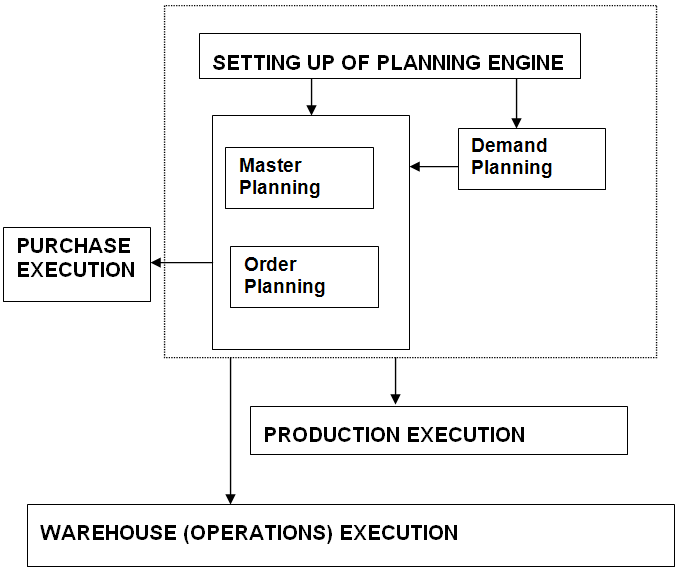
Having set up master data for enterprise planning to plan material requirements, the Demand Planning is used to generate forecast, based on historical sales data. The Master Planning performs the supply planning for independent demand items (end items). The Order Planning is used to perform the supply planning for dependent demand item(s) (components, raw materials). The supply plan for items is generated and transferred to the execution level. The execution level are the supply sources, such as purchase, production and distribution
Setting up of planning engine: This requires, inter alia, two important inputs:
- Forecast methods.
- Scenario parameters for the purpose of simulation.
Forecast methods: Following forecasting methods are available under enterprise planning
- Moving Average - the demand forecast is calculated as follows:
Demand + actual item issue/seasonal factor [for the relevant periods]
--------------------------------------------------------------------------------------------
Number of periodsIn essence, Moving average is an average of the past periods. Each time the moving average is calculated, the most recent period is added to the calculation and the oldest period is dropped.
- Exponential Smoothing - the demand forecast is calculated as follows:
Average demand (current period) + trend factor (current period) * seasonal factor (current period) Where:
- Average Demand is calculated as: forecast demand (previous period) + Smoothing Factor for Demand Forecast (current period) * actual usage(previous period) - forecast demand(previous period))/seasonal factor(previous period)
- Trend Factor is calculated as: trend factor(previous period) + Smoothing Factor for Demand Forecast (current period) * [average demand(current period) - average demand(previous period) - trend factor(previous period)]
- Seasonal Factors are defined.
- The Smoothing Factor is defined, in some cases corrected for Critical Tracking Signal Factor in the Forecast Methods.
In essence, a single exponential smoothing is a moving average with weighting factors applied. The greatest smoothing weight is applied to the most recent period and the least weight is applied to the oldest period.
- Previous Year’s Calculation - the demand forecast is identical to Moving Average, except that the number of periods to take into account is different.
- Last Period’s Demand - the demand forecast is calculated as follows:
Average demand (current period) * Seasonal factor (current period) Where: Average Demand is calculated as: actual item issue (previous period) / seasonal factor (previous period)
A recommendation of various forecasting methods is described in the following table:
| Moving Average | Exponential Smoothing | Previous year calculation | Demand Last period | |
| Understanding | Good | Neutral | Good | Very Good |
| Trend | Unsuitable | Very Good | Unsuitable | Neutral |
| Season | Neutral | Very Good | Very Good | Neutral |
| Unstable Demand/Supply | Neutral | Very Good | Neutral | Neutral |
Scenarios - Scenario is an identification of one out of various possible planning solutions. Each scenario represents one overall planning solution, and involves particular settings for the planning of items and resources. Scenarios are used to analyze and compare various planning options and to find the best planning solution. For example, demand forecasts or sourcing strategies can be varied for different scenarios. One of the scenarios is the actual scenario, which corresponds to the actual planning situation. Planned orders and production plans from the actual scenario are transferred to the execution level of the system.
Rolling Scenario
This represents a particular type of scenario that is shifted forward in time on a regular basis. In the course of time, the current date will reach or exceed a certain reference date plus the rolling frequency. When this is the case, the scenario’s start date and finish date, the plan period division, and the reference date itself are shifted forward
| Next ❯❯ |
 Related Articles
- Demand Planning & Master Planning
- Supply Chain & Distribution Planning
- Order based Planning
- Setting Up Service Module
- ERP Package - Sales Module
Authorship/Referencing - About the Author(s)
The article is Written and Reviewed by Management Study Guide Content Team. MSG Content Team comprises experienced Faculty Member, Professionals and Subject Matter Experts. We are a ISO 2001:2015 Certified Education Provider. To Know more, click on About Us. The use of this material is free for learning and education purpose. Please reference authorship of content used, including link(s) to ManagementStudyGuide.com and the content page url.