How Does Employee Engagement affect Financial Performance of a Company ?
Experts say that the engagement, involvement and satisfaction of the employees should be the biggest concern of the organisations. When they are actively engaged, it can directly affect the productivity and financial standing of the company. While it may not directly add to your profits but it certainly helps in several indirect ways.
There are numerous indicators that show that employee engagement has a strong impact on the financial performance of a company. However, the direct results are still debatable. There have been umpteen numbers of studies showing the link between employee engagement and financial profitability of an organisation but none of them produces sufficient evidences to establish it as a hard core fact.
Let’s take a glance at those factors related to employee engagement that indirectly contribute to the profitability of an organisation.
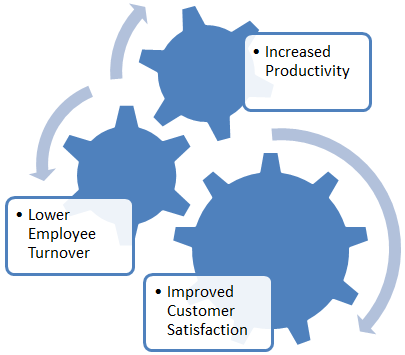
Indicators of Improved Financial Performance
Increased Productivity
When employees like to do what they are assigned, they are completely involved in their job to perform their best and bring desired results. The survey conducted by Hay Group, a global management consulting firm, revealed that engaged workforce are 40 percent more productive than those who are not engaged. When engagement level among employees increases, it increases their productivity which in turn, improves the financial standing of the organisation. Although the financial performance is not directly related to the employee engagement levels but it is believed that it is the main reason behind it.
Lower Employee Turnover
When employees are engaged in their jobs and are fully satisfied with their career as well as their organisation, they grow with it. There can be two main reasons why they look for alternatives. One, they are not interested in doing what is assigned to them and two, they are not happy with the organisation. But when they like their workplace, they stay with it and grow as it grows. This decreases the cost of finding new employees and training them from the beginning to perform a specific task. Without spending much time on training new employees, an organisation can continue to move forward with its existing employees without affecting the pace of business operations.
Improved Customer Satisfaction
When employees love their job, they will make every effort and go extra mile to offer complete assistance to the customers. The studies conducted by consulting firms and universities have shown the link between the employee engagement and customer satisfaction. This means when employees are satisfied, they happily serve customers resolving all their queries and doubts. They offer them genuine consultation and guidance. This helps in establishing long term relationships with the customers. It in turn, increases the number of loyal customers which is again a good sign for the organisation as a whole.
Besides this, there are many other factors that go into the productivity and profitability of an organisation. But like the above mentioned, they lack evidence for establishing a cause and effect or direct relationship between employee engagement and company’s financial performance. Besides this, there are numerous other factors apart from employee engagement level that have a strong impact on the financial status of a company. This is not the only one but is one of the most important ones.
| ❮❮ Previous | Next ❯❯ |
 Related Articles
- Employee Engagement Surveys
- Maslow’s Need Hierarchy
- Zinger Model of Employee Engagement
- Hewitt Employee Engagement Measure
- Hygiene and Motivation Factors
Authorship/Referencing - About the Author(s)

The article is Written and Reviewed by Management Study Guide Content Team. MSG Content Team comprises experienced Faculty Member, Professionals and Subject Matter Experts. We are a ISO 2001:2015 Certified Education Provider. To Know more, click on About Us. The use of this material is free for learning and education purpose. Please reference authorship of content used, including link(s) to ManagementStudyGuide.com and the content page url.